“Topps Tiffany” is a hobby nickname, not a term printed on the cards or used by Topps in marketing copy. The official product name was Collectors’ Edition factory sets. Over time, collectors adopted the term Tiffany to describe these premium-print versions.
This guide exists to answer one question accurately:
How do you determine whether a card is a regular Topps issue or a Topps Tiffany card, without guessing or relying on seller claims?
Everything below reflects documented hobby consensus from Beckett, PSA CardFacts, Cardboard Connection, and long-standing collector practice.

What “Topps Tiffany” Actually Is
Topps Tiffany cards are premium-print versions of standard designs, produced as Collectors’ Edition factory sets during the junk wax era.
They share the same layouts, photography, and checklist as regular issues, but differ in physical production.
Core production traits (this is the definition)
All reputable sources align on these traits:
-
Glossy coating on the front
-
Premium, brighter white cardboard stock compared to the regular issue
These traits are what define Tiffany.
Words like cleaner, crisper, or brighter are outcomes, not definitions.
Which Years and Products Count as “Topps Tiffany”
If a card is outside these products, it is not part of the classic Topps Tiffany run.
Topps Baseball (Flagship Base Sets)
-
1984 through 1991
Topps Traded Tiffany
-
Produced through 1991 Topps Traded
Bowman Collectors’ Edition (often called Bowman Tiffany)
-
1989 and 1990
Important clarification
When collectors say “1984–1991 Tiffany,” they are usually referring to the entire Tiffany program, which includes flagship base and Traded releases, not just the base set.
What Tiffany Is Not
-
It is not a condition designation
-
It is not defined by centering, color saturation, or print sharpness alone
-
It is not identified by stars or asterisks alone
-
It is not proven by a white back in every product
Those traits may appear, but they are not definitional.
The Correct Identification Workflow
This order matters. It avoids the most common hobby mistakes.
Step 1: Identify the exact product first
Before touching stock or gloss, determine whether the card is:
-
Topps flagship base
-
Topps Traded
-
Bowman Collectors’ Edition
Different products require different emphasis when identifying Tiffany.
Step 2: Flagship Base Sets (1984–1991)
Use the back-stock shortcut
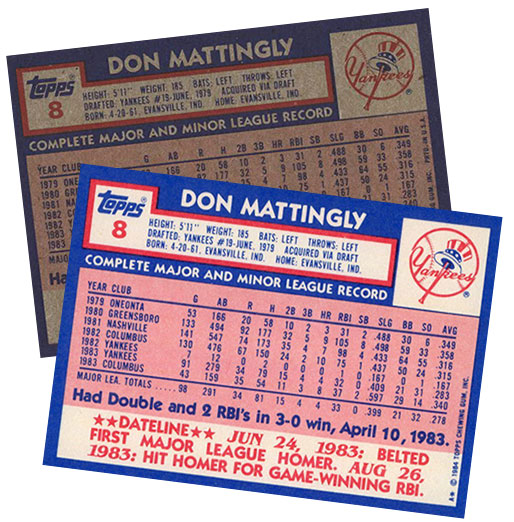
What you’re seeing
-
Regular Topps flagship: printed on gray cardboard stock
-
Topps Tiffany flagship: printed on bright white stock
This gray-vs-white distinction is widely documented and is why back color is a fast, reliable indicator for flagship base sets only.
Why this works here
Regular flagship Topps cards from this era consistently used gray stock. Tiffany did not.
Important limitation
This shortcut does not universally apply to Traded sets.
Step 3: Topps Traded Tiffany
Do not rely on back color alone
What you’re seeing
-
Both cards may appear to have white backs
-
The decisive difference is the front finish
What matters most here
-
Tiffany Traded: noticeably glossier front coating
-
Regular Traded: comparatively duller front
Because many regular Traded cards were also printed on white stock, white back alone is insufficient. This is one of the most common misidentification traps in the hobby.
Step 4: Confirm the front gloss
Especially critical when back color is inconclusive
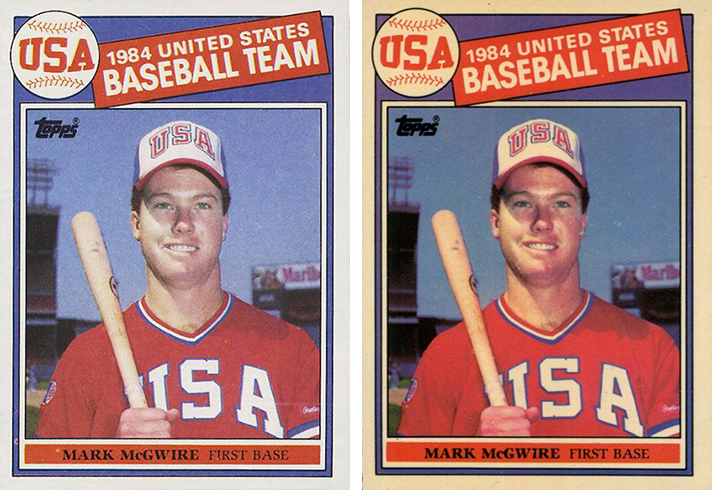
What you’re seeing
-
Tiffany: a consistent, reflective gloss layer across the card face
-
Regular: flatter, less reflective surface
Important nuance
Gloss is easiest to confirm in-hand, by tilting the card under a single light source. Photos can exaggerate or hide gloss depending on lighting and exposure.
Gloss is necessary, but it should always be evaluated alongside stock and product context.
The “Star / Asterisk Method”
Why it exists and why it’s misused

Image provided by CRDSHP supporter Martin. Much appreciated.
Some guides reference the presence of asterisks or stars in specific stat lines on certain cards.
What is accurate
-
These markers exist on some Tiffany cards
-
Beckett has discussed them as identification aids
What is not accurate
-
They are not universal
-
They do not define Tiffany
-
They should never be used alone
Treat stars only as supporting evidence, and only when the card already matches the correct product, year, stock, and gloss profile.
The Definitive Checklist
A card qualifies as Topps Tiffany (classic era) only when all of the following are true:
-
It comes from a recognized Tiffany/Collectors’ Edition product:
-
Topps flagship base (1984–1991)
-
Topps Traded Tiffany (through 1991 Traded)
-
Bowman Collectors’ Edition (1989–1990)
-
-
It has a Tiffany-style glossy front
-
It is printed on premium white stock
-
With the gray-vs-white back shortcut applying reliably only to flagship base sets
-
If you cannot verify these core traits, the correct designation is “unconfirmed,” not “Tiffany.”
Storage Consideration
Glossy fronts show surface defects more readily. If you are handling confirmed or suspected Tiffany cards:
-
Sleeve immediately
-
Use clean top loaders or semi-rigids
-
Minimize sliding or repeated handling
Protective supplies:
https://crdshp.com/collections/accessories
Final Statement
Topps Tiffany cards are defined by how they were made, not how they look at first glance.
If a card:
-
Is from the correct product and year
-
Has a glossy front
-
Uses premium white stock
Then it qualifies.
If any of those are uncertain, do not label it Tiffany.